Apple Chlorotic Leaf Spot Virus (ACLSV) - DAS ELISA Home Products Testing Services Supplies Contact Us
Catalog #: V148
Source Antibody: A rabbit polyclonal antibody for both capture and detection.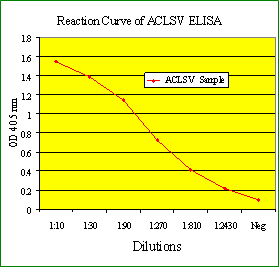
Test Format: DAS ELISA
Reactivity: The test reacted with all ACLSV isolates tested. Reaction of the ELISA is moderate strong. Optical Density at 405nm is in arrange of 0.300 - >1.800 depending on the virus titer in the samples tested.
Sensitivity: Sensitivity of the ELISA is moderate high. The virus can be consistently detected in infected plant tissues diluted at 1:90 -1:810.
Specificity: There is no cross reaction with healthy plant tissues such as apple or other host plants. Background is low on all of the negative control wells.
Application: The test can be used to detect ACLSV in infected herbaceous host plant tissues. Detection of ACLSV in infected woody plant tissues are not consistent, and are depending on the viral titers in the sample tissues.
Products:
|
Catalog Number |
Description |
Test Wells | Price $USD | Ship Weight (Estimated) |
|
V148-R1 |
ELISA Reagents, Alkaline Phosphatase |
500 |
275 |
2 lb (1 kg) |
|
V148-R2 |
ELISA Reagents, Alkaline Phosphatase |
1000 |
470 |
3 lb (1.5 kg) |
|
V148-R3 |
ELISA Reagents, Alkaline Phosphatase |
5000 |
1860 |
12 lb (6 kg) |
| V148-R4 | ELISA Reagents, Alkaline Phosphatase |
100 |
105 |
1 lb (0.5 kg) |
| V148-K1 | ELISA Kit, Alkaline Phosphatase |
500 |
435 |
2 lb (1 kg) |
| V148-K2 | ELISA Kit, Alkaline Phosphatase |
1000 |
690 |
3 lb (1.5 kg) |
|
V148-C1 |
Coating Antibody |
500 |
140 |
2 lb (1 kg) |
|
V148-C2 |
Coating Antibody |
1000 |
260 |
2 lb (1 kg) |
|
V148-C3 |
Coating Antibody |
5000 |
885 |
2 lb (1 kg) |
|
V148-D1 |
Detecting conjugate, Alkaline Phosphatase |
500 |
190 |
2 lb (1 kg) |
|
V148-D2 |
Detecting conjugate, Alkaline Phosphatase |
1000 |
315 |
2 lb (1 kg) |
|
V148-D3 |
Detecting conjugate, Alkaline Phosphatase |
5000 |
1080 |
2 lb (1 kg) |
|
V148-P2 |
ELISA control, positive |
18 |
20 |
1 lb (0.5 kg) |
|
V148-N1 |
Negative control |
18 |
20 |
1 lb (0.5 kg) |
| M004-1 | Buffers for DAS/TAS, alkaline phosphatase | 500 | 130 |
2 lb (1.0 kg) |
| M004-2 | Buffers for DAS/TAS, alkaline phosphatase | 1000 | 220 |
3 lb (1.5 kg) |
| M004-3 | Buffers for DAS/TAS, alkaline phosphatase | 5000 | 900 |
6 lb (3.0 kg) |
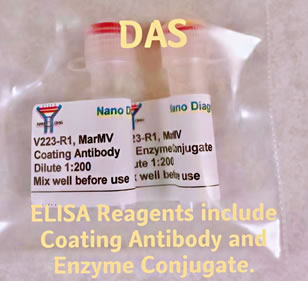 ELISA Reagents include Coating Antibody and Enzyme Conjugate.
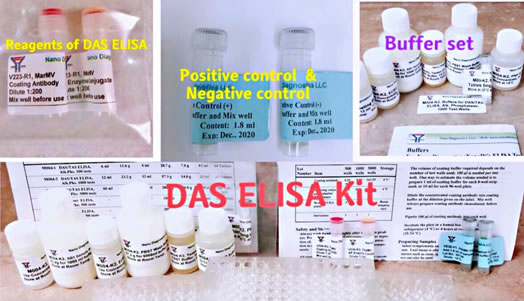
ELISA Kits include Coating Antibody and Enzyme Conjugate, all Buffer sets, Positive/Negative controls and all plates.
It is easy and convenient To Place An Order
To know more about the products: Product Items
To learn how to perform the test: Instructions for DAS ELISA
To be familiar with other components: Buffer Sets; Controls
Information About the Virus
Name: Apple Chlorotic Leaf Spot Virus
Acronym: ACLSV
Synonyms: pear ring pattern mosaic virus (Cropley, 1969), apple latent virus type 1, plum pseudopox virus, quince stunt virus.
Group/Genus: Trichovirus
Vector: Transmitted by eudorylamoid nematodes (Fritzsche and Kegler, 1968); an unconfirmed report.
Transmission: transmitted by mechanical inoculation; transmitted by grafting (possibly by root-grafts; Gilmer et al., 1971); not transmitted by seed.
Main natural host plants: Malus platycarpa, Malus sylvestris cv. R12740-7A, Malus sylvestris cv. Spy, Malus sylvestris cv. Virginia Crab - stem pitting, Cydonia oblonga (Quince) C7/1, Pyronia veitchii - chlorosis and stunting, Pyrus communis - ring patterns, mosaic, Crataegus spp. - chlorotic ring spots, Prunus armeniaca - ring patterns, mosaic, Prunus spinosa - chlorotic ringspot patterns, Prunus persica, Prunus domestica and Prunus armeniaca.
Virus Infection: Symptoms caused by viral infection include chlorotic leaf spots and stem pitting, line patterns and chlorotic rings, chlorotic spots and stem pitting, chlorosis and stunting, dark green mottle, bark split and pseudopox.
Diagnostically susceptible host species and symptoms: Malus sylvestris cv. R12740-7A - asymmetric blotches and malformation of young leaves; M. platycarpa (Long Ashton clone) - irregular chlorotic rings and line patterns, small leaves shed prematurely, malformation; Chenopodium quinoa - large etched local lesions, becoming necrotic, systemic chlorotic spotting, mottling, ring and line patterns, chlorosis and necrosis; C. amaranticolor - chlorotic local lesions, surrounded by necrotic dots; Phaseolus vulgaris cvs Pinto, Bountiful, Kinghorn - purple-brown necrotic spots or rings (1-3 mm), not systemic..
Geographical distribution: Probably distributed worldwide (and probably wherever apples are cultivated). Spreads in the Eastern Asian region, the Eurasian region, the North American region, and the Pacific region; Australia, China, and New Zealand.
References:
1. German, S., Candresse, T., Le Gall, O., Lanneau, M. and Dunez, J. (1992). J. gen. Virol. 73: 767.
2. Lister, R.M. (1970). CMI/AAB Descr. Pl. Viruses No. 30, 4 pp.
3. Lister, R.M. and Bar-Joseph, M. (1981). Closteroviruses. In: Handbook of Plant Virus Infections and Comparative Diagnosis, p. 809; ed. E. Kurstak. Elsevier/North-Holland Biomedical Press.