Beet Curly Top Virus (BCTV) - TAS ELISA Home Products Testing Services Supplies Contact Us
Catalog #: V005
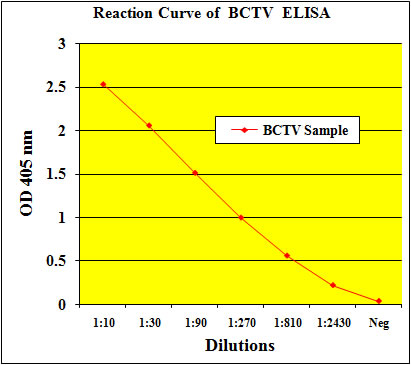
Source Antibody: A rabbit anti-BCTV polyclonal antibody (UID16) and guinea pig anti-BCTV polyclonal antibody (GP-1) for detection.
Test Format: TAS ELISA
Reactivity: This test system reacted with all BCTV isolates tested. Reaction of the ELISA is strong. Optical Density at 405nm is in a range of 0.900 - >2.500 depending on the virus titer in the samples tested. This test reacts with three Curtovirus species beet severe curly top virus (BSCTV), beet mild curly top virus (BMCTV), and beet curly top virus (BCTV).
Sensitivity: Sensitivity of the ELISA is relative high. The
virus can be consistently detected in infected plant leaf tissues diluted
at
1:810-1: 2430
Specificity: There is no cross reaction with healthy beet plant tissues. Background is very low on all of the negative control wells.
Application: The test can be used to detect BCTV , BMCTV and BSCTV in infected beet plant tissues including roots, stems and leaves.
Products:
|
Catalog Number |
Description | Test Wells | Price $USD | Ship
Weight (Estimated) |
|
V005-R1 |
ELISA Reagents, Alkaline Phosphatase |
500 |
275 |
2 lb (1 kg) |
|
V005-R2 |
ELISA Reagents, Alkaline Phosphatase |
1000 |
470 |
3 lb (1.5 kg) |
|
V005-R3 |
ELISA Reagents, Alkaline Phosphatase |
5000 |
1860 |
12 lb (6 kg) |
| V005-R4 | ELISA Reagents, Alkaline Phosphatase |
100 |
105 |
1 lb (0.5 kg) |
| V005-K1 | ELISA Kit, Alkaline Phosphatase |
500 |
435 |
2 lb (1 kg) |
| V005-K2 | ELISA Kit, Alkaline Phosphatase |
1000 |
690 |
3 lb (1.5 kg) |
|
V005-C1 |
Coating Antibody |
500 |
140 |
2 lb (1 kg) |
|
V005-C2 |
Coating Antibody |
1000 |
260 |
2 lb (1 kg) |
|
V005-C3 |
Coating Antibody |
5000 |
885 |
2 lb (1 kg) |
|
V005-D1 |
Detecting conjugate, Alkaline Phosphatase |
500 |
190 |
2 lb (1 kg) |
|
V005-D2 |
Detecting conjugate, Alkaline Phosphatase |
1000 |
315 |
2 lb (1 kg) |
|
V005-D3 |
Detecting conjugate, Alkaline Phosphatase |
5000 |
1080 |
2 lb (1 kg) |
|
V005-P1 |
Positive control |
18 |
20 |
1 lb (0.5 kg) |
|
V005-N1 |
Negative control |
18 |
20 |
1 lb (0.5 kg) |
| M004-1 | Buffers for DAS/TAS, alkaline phosphatase | 500 | 130 |
2 lb (1.0 kg) |
| M004-2 | Buffers for DAS/TAS, alkaline phosphatase | 1000 | 230 |
3 lb (1.5 kg) |
| M004-3 | Buffers for DAS/TAS, alkaline phosphatase | 5000 | 900 |
6 lb (3.0 kg) |
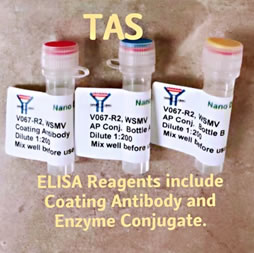 ELISA Reagents include Coating Antibody and Enzyme Conjugate.
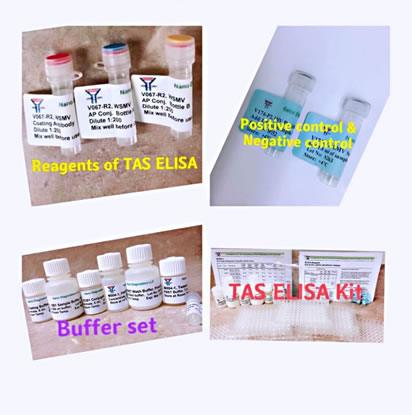 ELISA Kits include Coating Antibody and Enzyme Conjugate, all Buffer sets, Positive/Negative controls and all plates
It is asy and convenient To Place
An Order
To know more about the products: Product
Items
To learn how to perform the test:
Instruction for TAS ELISA Reagents
To be familiar with other components: Buffer
Sets; Controls
Information About the Virus
Name: Beet Curly Top Virus
Acronym: BCTV
Family: Geminiviridae
Group/Genus: Curtovirus
Curly top is caused by any of three Curtovirus species Beet severe curly top virus (BSCTV), Beet mild curly top virus (BMCTV), and Beet curly top virus (BCTV).
Transmission: Transmitted by a vector; an insect; Circulifer tenellus in N. America, C. tenellus, C. opacipennis in Mediterranean Basin; Cicadellidae. Transmitted in a persistent manner. Virus retained when the vector moults; does not multiply in the vector; not transmitted congenitally to the progeny of the vector; not transmitted by mechanical inoculation (unless special procedures used); transmitted by grafting (by dodder from plants that are not hosts of the vector); not transmitted by seed.
Main host plants: Beta vulgaris - vein-clearing and upward and inward rolling of leaves. Vein swelling and galling to give rough abaxial leaf surface. Phloem exudate on petioles and large leaf veins, phloem necrosis in roots. Cucumis sativus - seedlings killed. Older plants stunted and malformed, leaves rolled upward. Phaseolus vulgaris cv. Bountiful - first trifoliate leaf epinastic. Buds of survivors proliferate, leaflets brittle, curled and crinkled.
Geographical distribution: Spreads in the African region, the Eurasian region, the Mediterranean region, the North American region, and the South and Central American region (in the arid and semi-arid regions of the west); Argentina, Bolivia, Brazil, Canada, Costa Rica, Cyprus, Egypt, India, Iran, Italy, Mexico, Puerto Rico, Spain, Turkey, the USA, and Uruguay.
Reference:
1. Bennett, Monogr. Am. Phytopath. Soc. No. 7, 81 pp., 1971.
2. Egbert, Egbert & Mumford, Abs. Ann. Meet. Am. Soc. Microbiol. 1976, p. 258, 1976.
3. Esau, J. Ultrastruct. Res. 61: 78, 1977.
4. Mumford & Thornley, Phytopathology News 12:192, 1978.
5. Thomas, Phytopathology 67: 903, 1977.