
Source Antibody: Use a rabbit polyclonal antibodies made against BYDV-strain 204 for both capture and detection.
Test Format: DAS ELISA
Bean Yellow Mosaic Virus - Strain 204 (BYMV-204) - DAS ELISA Home Products Testing Services Supplies Contact Us
Catalog #: V118
Source Antibody: Use a rabbit polyclonal antibodies made against BYDV-strain 204 for both capture and detection.
Test Format: DAS ELISA
Reactivity: This test system detects all known isolates of BYMV - strain 204 and other serological related isolates. This test does not react with BYMV - strain B-25 and some other serological distant isolates. Reaction of the ELISA is strong. Optical Density at 405nm is in arrange of 1.500 - 2.000 depending on the virus titer in the samples tested.
Sensitivity: Sensitivity of the ELISA is relatively high. The virus can be consistently detected in infected plant tissues diluted at 1:810.
Specificity: There is no cross reaction with healthy plant tissues such as bean and soybean. Background is moderately low on the negative control wells.
Application: The test can be used to detect BYMV - strain 204 and other serological related isolates in infected host plants.
Products:
|
Catalog Number |
Description |
Test Wells | Price $USD | Ship Weight (Estimated) |
V118-R1 |
ELISA Reagents, Alkaline Phosphatase |
500 |
270 |
2 lb (1 kg) |
V118-R2 |
ELISA Reagents, Alkaline Phosphatase |
1000 |
460 |
3 lb (1.5 kg) |
V118-R3 |
ELISA Reagents, Alkaline Phosphatase |
5000 |
1860 |
12 lb (6 kg) |
| V118-R4 | ELISA Reagents, Alkaline Phosphatase | 100 |
105 |
1 lb (0.5 kg) |
| V118-K1 | ELISA Kit, Alkaline Phosphatase | 500 |
435 |
2 lb (1 kg) |
| V118-K2 | ELISA Kit, Alkaline Phosphatase | 1000 |
690 |
3 lb (1.5 kg) |
V118-C1 |
Coating Antibody |
500 |
140 |
2 lb (1 kg) |
V118-C2 |
Coating Antibody |
1000 |
260 |
2 lb (1 kg) |
V118-C3 |
Coating Antibody |
5000 |
885 |
2 lb (1 kg) |
V118-D1 |
Detecting conjugate, Alkaline Phosphatase |
500 |
170 |
2 lb (1 kg) |
V118-D2 |
Detecting conjugate, Alkaline Phosphatase |
1000 |
280 |
2 lb (1 kg) |
V118-D3 |
Detecting conjugate, Alkaline Phosphatase |
5000 |
1060 |
2 lb (1 kg) |
| V118-P2 | ELISA control, Positive | 18 |
20 |
1 lb (0.5 kg) |
V118-N1 |
Negative control |
18 |
20 |
1 lb (0.5 kg) |
| M004-1 | Buffers for DAS/TAS, alkaline phosphatase | 500 | 130 |
2 lb (1.0 kg) |
| M004-2 | Buffers for DAS/TAS, alkaline phosphatase | 1000 | 220 |
3 lb (1.5 kg) |
| M004-3 | Buffers for DAS/TAS, alkaline phosphatase | 5000 | 900 |
6 lb (3.0 kg) |
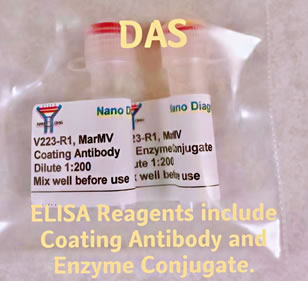 ELISA Reagents include Coating Antibody and Enzyme Conjugate.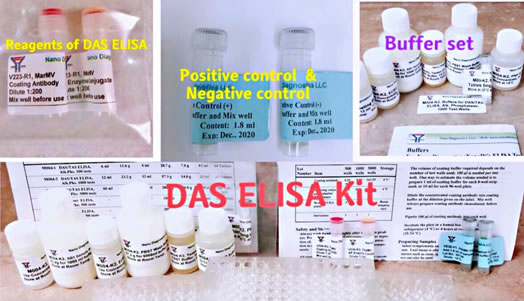
It is easy and convenient To Place An Order
To know more about the products: Product Items
To learn how to perform the test: Instructions for DAS ELIAS
To be familiar with other components: Buffer Sets; Controls
Information About the Virus
Name: Bean Yellow Mosaic Virus
Acronym: BYMV
Synonyms: bean virus 2, canna mosaic virus (Brierley and Smith, 1948), gladiolus mosaic virus, gloriosa stripe mosaic virus.
Stains: There are many viral strains including Croatian clover mosaic virus (Taraku et al. 1977), dipladenia mosaic virus (Paludan et al., 1988), pea mosaic 1 virus, pea 2 virus, pisum 2 virus, pea common mosaic virus. Scott's isolate, B-25 and isolates from Gladiolus spp. are considered typical isolates. Pea mosaic virus (PMV) 204 and other isolates from clovers are more distant.
Group/Genus: Potyviruses
Vector: Transmitted by a vector; an insect; more than 20 spp. including Acyrthosiphon pisum, Macrosiphum euphorbiae, Myzus persicae, Aphis fabae; Aphididae. Transmitted in a non-persistent manner.
Transmission: Virus transmitted by mechanical inoculation; transmitted by seed (to 3%).
Main natural host plants: Phaseolus vulgaris and Pisum sativum, Gladiolus sp., Freesia sp., Lupinus luteus, Robinia pseudoacacia, Trigonella foenum-graecum, Vicia sativa, Papaver somniferum, Arachis hypogaea, Crotalaria spectabilis, Glycine max, Canna spp., Trifolium subterraneum, Eustoma russellianum, Vicia faba, Medicago sativa, Trifolium hybridum, T. vesiculosum, T. incarnatum, T. pratense, T. repens.
Virus Infection: Symptoms include mosaics, leaf mottling, tip necrosis, and leaf malformation. Symptoms vary seasonally.
Diagnostically susceptible host species and symptoms: Gomphrena globosa - necrotic local lesions; not systemic; Chenopodium amaranticolor, C. quinoa - necrotic local lesions with red border; some systemic chlorotic vein banding and spots; Phaseolus vulgaris - necrotic or chlorotic local lesions; systemic mosaic; Pisum sativum - Perfection types not infected; systemic mosaic in others; Vicia faba - mild systemic mosaic.
References:
1. Barnett, O.W., Randles, J.W. and Burrows, P.M. (1987). Phytopathology 77: 791.
2. Bos, L. (1970). CMI/AAB Descr. Pl. Viruses No. 40, 4 pp.
3. McLaughlin, M.R. (1988). Plant Dis. 72: 539.