Celery Mosaic Virus (CeMV) - DAS ELISA Home Products Testing Services Supplies Contact Us
Catalog #: V168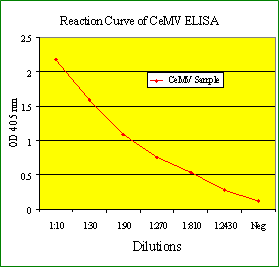
Source Antibody: Rabbit polyclonal antibody for both capture and
detection.
Test Format: DAS ELISA
Reactivity: The test reacted with all CeMV isolates tested. Reaction of the ELISA is moderate strong. Optical Density at 405nm is in arrange of 0.850 - >3.000 depending on the virus titer in the samples tested.
Sensitivity: Sensitivity of the ELISA is high. The virus can be consistently detected in infected plant tissues diluted at 1:810 - 1:2430.
Specificity: There is no cross reaction with healthy plant tissues such as celery or other host plants. Background is low on all of the negative control wells.
Application: The test can be used to detect CeMV in infected host plants.
Products:
|
Catalog Number |
Description |
Test Wells | Price $USD |
Ship
Weight (Estimated) |
|
V168-R1 |
ELISA Reagents, Alkaline Phosphatase |
500 |
275 |
2 lb (1 kg) |
|
V168-R2 |
ELISA Reagents, Alkaline Phosphatase |
1000 |
470 |
3 lb (1.5 kg) |
|
V168-R3 |
ELISA Reagents, Alkaline Phosphatase |
5000 |
1860 |
12 lb (6 kg) |
| V168-R4 | ELISA Reagents, Alkaline Phosphatase |
100 |
105 |
1 lb (0.5 kg) |
| V168-K1 | ELISA Kit, Alkaline Phosphatase |
500 |
435 |
2 lb (1 kg) |
| V168-K2 | ELISA Kit, Alkaline Phosphatase |
1000 |
690 |
3 lb (1.5 kg) |
|
V168-C1 |
Coating Antibody |
500 |
140 |
2 lb (1 kg) |
|
V168-C2 |
Coating Antibody |
1000 |
260 |
2 lb (1 kg) |
|
V168-C3 |
Coating Antibody |
5000 |
885 |
2 lb (1 kg) |
|
V168-D1 |
Detecting conjugate, Alkaline Phosphatase |
500 |
190 |
2 lb (1 kg) |
|
V168-D2 |
Detecting conjugate, Alkaline Phosphatase |
1000 |
315 |
2 lb (1 kg) |
|
V168-D3 |
Detecting conjugate, Alkaline Phosphatase |
5000 |
1080 |
2 lb (1 kg) |
|
V168-P2 |
ELISA control, positive |
18 |
20 |
1 lb (0.5 kg) |
|
V168-N1 |
Negative control |
18 |
20 |
1 lb (0.5 kg) |
| M004-1 | Buffers for DAS/TAS, alkaline phosphatase | 500 | 130 |
2 lb (1.0 kg) |
| M004-2 | Buffers for DAS/TAS, alkaline phosphatase | 1000 | 220 |
3 lb (1.5 kg) |
| M004-3 | Buffers for DAS/TAS, alkaline phosphatase | 5000 | 900 |
6 lb (3.0 kg) |
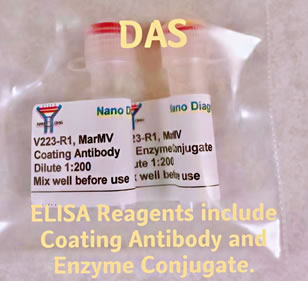 ELISA Reagents include Coating Antibody and Enzyme Conjugate and all plates.
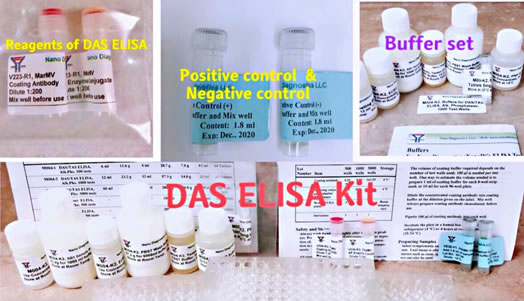
ELISA Kits include Coating Antibody and Enzyme Conjugate, all Buffer sets, Positive/Negative controls and all plates.
It is easy and convenient To Place
An Order
To know more about the products: Product
Items
To learn how to perform the test: Instructions
for DAS ELISA
To be familiar with other components: Buffer
Sets; Controls
Information About the Virus
Name: Celery Mosaic Virus
Acronym: CeMV
Synonyms: apium virus 1, celery western mosaic virus, celery
ringspot virus (Hollings, 1964; Pemberton and Frost, 1986).
Group/Genus: Potyvirus
Vector: Transmitted by a vector; an insect; Myzus persicae, Aphis
middletonii, A. ferruginea-striata; A. apigraveolens, A. apii, A. gossypii, A.
rumicis, Cavariella capreae, Myzus circumflexus, M. convolvuli, Rhopalosiphum
melliferum; Cavariella aegopodii, C. pastinacae (Severin and Freitag, 1968;
Walkey et al., 1970); Aphididae. Transmitted in a non-persistent manner.
Transmission: Virus transmitted by mechanical inoculation; not
transmitted by contact between plants; not transmitted by seed.
Main natural host plants: Apium graveolens var. dulce,
Conium maculatum, Pastinaca sativa, Petroselinum crispum,
Coriandrum sativum - chlorosis, stunted, Daucus carota - mosaic,
Anethum graveolens.
Virus Infection: Symptoms include systemic mottling, malformation of
leaflets, crinkly leaves, chlorosis and necrotic spots, stunted and malformed.
Symptoms persist.
Diagnostically susceptible host species and symptoms: Apium graveolens
var. dulce - mottled and malformed leaflets; Conium maculatum -
mottled and leaves malformed (Sutabutra, 1968); Pastinaca sativa - leaves
malformed; Daucus carota ssp. sativus chlorotic spots;
Coriandrum sativum - systemic chlorosis.
Geographical distribution: Probably distributed worldwide. Spreads in Argentina (Gracia and Feldman, 1977), Australia (western Australia), Canada (Kemp and Froud, 1975), the former Czechoslovakia (Chod, 1984)), France (Marchoux et al., 1969), Germany (Brandes and Luisoni, 1966), Italy (Avgelis and Quacquarelli, 1972), Japan (Iwaki and Komuro, 1970), New Zealand (Fry and Proctor, 1968), the UK (Walkey et al., 1970), the USA (in the western states and Florida (Purcifull and Shepard, 1967)).
References:
1. Pemberton, A.W. and Frost, R.R. (1986). Ann. appl. Biol.
108: 319.
2. Shepard, J.F. and Grogan, R.G. (1971). CMI/AAB Descr. Pl.
Viruses No. 50, 3 pp.