Curtobacterium flaccumfaciens pv flaccumfaciens (Cff) - DAS ELISA
Catalog #: B278
Source Antibody: Rabbit polyclonal antibody for both capture and detection.
Test Format: DAS ELISA
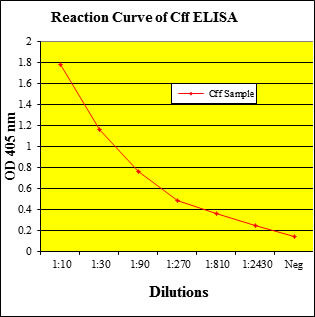
Reactivity: Reaction of the ELISA is moderately strong. Optical Density at 405nm is in a range of 0.650 - 1700. depending on the bacterial titer in the samples tested.
Sensitivity: Sensitivity of the ELISA is relatively high. The bacteria can be consistently detected in infected plant tissues diluted at 1:90 - 270.
Specificity: This test system has no cross reaction with healthy plant tissues tested. Background is relatively low on the negative control wells.
Products:
Catalog Number |
Description |
Test Wells |
Price $USD |
Ship Weight |
B278-R1 |
ELISA Reagents, Alkaline Phosphatase |
500 |
310 |
2 lb (1 kg) |
B278-R2 |
ELISA Reagents, Alkaline Phosphatase |
1000 |
550 |
3 lb (1.5 kg) |
B278-R3 |
ELISA Reagents, Alkaline Phosphatase |
5000 |
2300 |
12 lb (6 kg) |
B278-R4 |
ELISA Reagents, Alkaline Phosphatase |
100 |
160 |
1 lb (0.5 kg) |
B278-K1 |
ELISA Kit, Alkaline Phosphatase |
500 |
460 |
2 lb (1 kg) |
B278-K2 |
ELISA Kit, Alkaline Phosphatase |
1000 |
750 |
3 lb (1.5 kg) |
B278-C1 |
Coating Antibody |
500 |
150 |
2 lb (1 kg) |
B278-C2 |
Coating Antibody |
1000 |
280 |
2 lb (1 kg) |
B278-C3 |
Coating Antibody |
5000 |
980 |
2 lb (1 kg) |
B278-D1 |
Detecting conjugate, Alkaline Phosphatase |
500 |
210 |
2 lb (1 kg) |
B278-D2 |
Detecting conjugate, Alkaline Phosphatase |
1000 |
350 |
2 lb (1 kg) |
B278-D3 |
Detecting conjugate, Alkaline Phosphatase |
5000 |
1180 |
2 lb (1 kg) |
B278-P1 |
ELISA control, positive |
18 |
20 |
1 lb (0.5 kg) |
B278-N1 |
Negative control |
18 |
20 |
1 lb (0.5 kg) |
M004-1 |
Buffers for DAS/TAS, alkaline phosphatase |
500 |
130 | 2 lb (1.0 kg) |
M004-2 |
Buffers for DAS/TAS, alkaline phosphatase |
1000 |
220 | 3 lb (1.5 kg) |
M004-3 |
Buffers for DAS/TAS, alkaline phosphatase |
5000 |
900 | 6 lb (3.0 kg) |
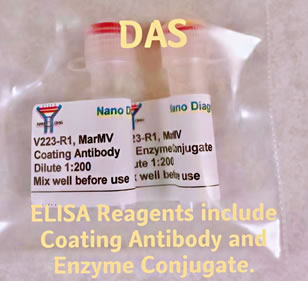 ELISA Reagents include Coating Antibody and Enzyme Conjugate.
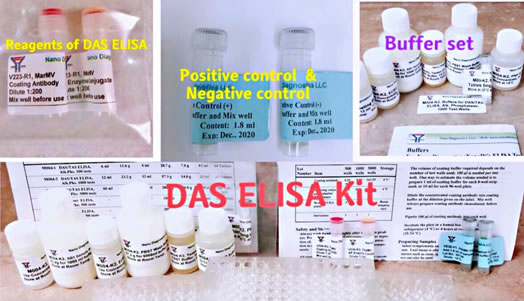
ELISA Kits include Coating Antibody and Enzyme Conjugate, all Buffer sets, Positive/Negative controls and all plates.
It is easy and convenient: To Place An Order
To know more about the products: Product Items
To learn how to perform the test: Instructions for DAS ELISA
To be familiar with other components: Buffer Sets; Controls
Information About the Virus
Name: Curtobacterium flaccumfaciens pv flaccumfaciens
Acronym: Cff
Genus: Curtobacterium
Host plants and Diseases: Curtobacterium flaccumfaciens pv. flaccumfaciens is the causal agent of the bacterial wilt disease of Phaseolus spp. and is a systemic bacterium.
Symptoms: The disease is characterized by the wilting of leaves, or parts of them, initially during the warmest hours of the day, followed by a recovery as the temperature drops in the evening. Wilting becomes permanent during the following days as a result of bacterial plugging of the vessels when the water supply is cut off; the leaves turn brown and then drop.
Bacterial Transmission: Cff can be transmitted to soybean seeds of susceptible cultivars at low rates.
Bacterial Infection: Gram-positive bacterium characteristics include small irregular rods, lateral flagella, the ability to persist in aerobic environments, and cells containing catalase. Phaseolus plants, 5–8 cm tall, may be attacked and are usually killed. If plants survive an early attack, or are infected at a later stage of growth, they may live throughout the season and bear mature seed.
Geographical Distribution: In Europe (Belgium, Greece, Mainland Greece, Hungary, Italy, Poland, Romania, Russia, Far East, Southern Russia, Spain, Mainland Spain, Ukraine), Asia (Turkey), Africa (Kenya, Mauritius, Tunisia), North America (Canada, Alberta, Manitoba, Ontario, Saskatchewan), USA (Colorado, Connecticut, Idaho, Iowa, Michigan, Montana, Nebraska, North Dakota, Ohio, Oregon, Virginia, Wisconsin, Wyoming), South America (Brazil, Goias, Minas Gerais, Santa Catarina, Sao Paulo, Colombia, Venezuela), Oceania (Australia, New South Wales, Queensland, South Australia, Victoria).
Reference:
R. M. Soares, Et al, Tropical Plant Pathology volume 43, pages376–379(2018).