Pseudomonas syringae pv lachrymans (Psl) - DAS ELISA
Catalog #: B279
Source Antibody: Rabbit polyclonal antibody for both capture and detection.
Test Format: DAS ELISA
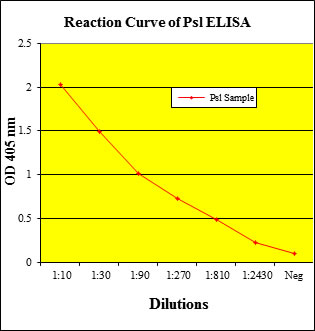
Reactivity: Reaction of the ELISA is strong. Optical Density at 405nm is in a range of 0.750 – 2.100. depending on the bacterial titer in the samples tested.
Sensitivity: Sensitivity of the ELISA is high. The bacteria can be consistently detected in infected plant tissues diluted at 1:270 - 810.
Specificity: This test system has no cross reaction with healthy plant tissues tested. Background is very low on the negative control wells.
Products:
Catalog Number |
Description |
Test Wells |
Price $USD |
Ship Weight |
B279-R1 |
ELISA Reagents, Alkaline Phosphatase |
500 |
310 |
2 lb (1 kg) |
B279-R2 |
ELISA Reagents, Alkaline Phosphatase |
1000 |
550 |
3 lb (1.5 kg) |
B279-R3 |
ELISA Reagents, Alkaline Phosphatase |
5000 |
2300 |
12 lb (6 kg) |
B279-R4 |
ELISA Reagents, Alkaline Phosphatase |
100 |
160 |
1 lb (0.5 kg) |
B279-K1 |
ELISA Kit, Alkaline Phosphatase |
500 |
460 |
2 lb (1 kg) |
B279-K2 |
ELISA Kit, Alkaline Phosphatase |
1000 |
750 |
3 lb (1.5 kg) |
B279-C1 |
Coating Antibody |
500 |
150 |
2 lb (1 kg) |
B279-C2 |
Coating Antibody |
1000 |
280 |
2 lb (1 kg) |
B279-C3 |
Coating Antibody |
5000 |
980 |
2 lb (1 kg) |
B279-D1 |
Detecting conjugate, Alkaline Phosphatase |
500 |
210 |
2 lb (1 kg) |
B279-D2 |
Detecting conjugate, Alkaline Phosphatase |
1000 |
350 |
2 lb (1 kg) |
B279-D3 |
Detecting conjugate, Alkaline Phosphatase |
5000 |
1180 |
2 lb (1 kg) |
B279-P1 |
ELISA control, positive |
18 |
20 |
1 lb (0.5 kg) |
B279-N1 |
Negative control |
18 |
20 |
1 lb (0.5 kg) |
M004-1 |
Buffers for DAS/TAS, alkaline phosphatase |
500 |
130 | 2 lb (1.0 kg) |
M004-2 |
Buffers for DAS/TAS, alkaline phosphatase |
1000 |
220 | 3 lb (1.5 kg) |
M004-3 |
Buffers for DAS/TAS, alkaline phosphatase |
5000 |
900 | 6 lb (3.0 kg) |
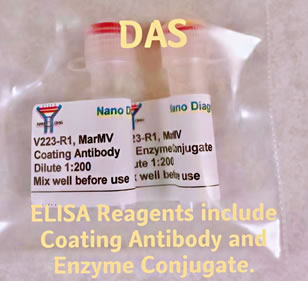 ELISA Reagents include Coating Antibody and Enzyme Conjugate.
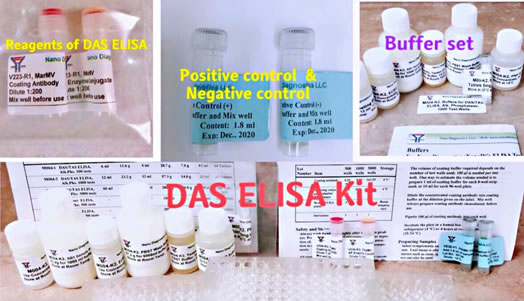
ELISA Kits include Coating Antibody and Enzyme Conjugate, all Buffer sets, Positive/Negative controls and all plates.
It is easy and convenient: To Place An Order
To know more about the products: Product Items
To learn how to perform the test: Instructions for DAS ELISA
To be familiar with other components: Buffer Sets; Controls
Information About the Virus
Name: Pseudomonas syringae pv lachrymans
Acronym: Psl
Genus: Pseudomonas
Host plants and Diseases: Angular leaf spot, caused by the bacterium Pseudomonas syringae pv. lachrymans, is most severe on cucumber, zucchini squash, and honeydew melon. it also can infect muskmelon, cantaloupe, watermelon, other squashes, pumpkin, and various gourds.
Symptoms: On cucumber, leaf symptoms appear as small, round to irregularly shaped, water-soaked lesions. The spots expand until they are limited by larger veins, which give the spots an angular appearance. Under humid conditions, water-soaked spots are covered by a white exudate, which eventually dries to form a thin, white crust on or adjacent to the spot on the under leaf surface.
Bacterial Transmission: The Pseudomonas bacterium is a seedborne pathogen.
Bacterial Infection: The pathogen can overwinter in infested crop residues and in seeds. This disease is widespread and particularly damaging after extended and frequent summer rains, especially when temperatures are between 75 and 82 F.
Geographical Distribution: the bacterial disease is distributed worldwide, including many countries in Africa, Asia, Europe, north America and south America.
Reference:
https://wiki.bugwood.org/Pseudomonas_syringae_pv._lachrymans_(Angular_Leaf_Spot_of_cucurbits).