Sugarcane Mosaic Virus (SCMV) - DAS ELISA Home Products Testing Services Supplies
Catalog #: V115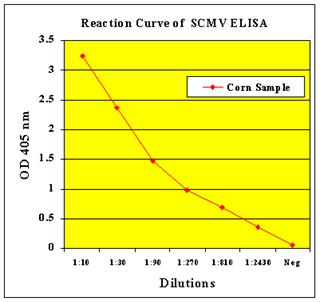
Source Antibody: Rabbit polyclonal antibody for both capture and
detection.
Test Format: DAS ELISA
Reactivity: This test reacted equally with all isolates of SCMV tested. Reaction of the ELISA is very strong. Optical Density at 405nm is in a range of 1.5 - 3.000 depending on the virus titer in the samples tested.
Sensitivity: Sensitivity of the ELISA is very high. The virus can be consistently detected in infected plant tissues diluted at 1:810 - 1:2430.
Specificity: This test system shows no cross-reaction with maize dwarf mosaic virus (MDMV) and johnsongrass mosaic virus (JGMV). There is also no cross-reaction found with other potyviruses tested, such as lettuce mosaic virus, papaya ringspot virus, potato virus A, potato virus Y, soybean mosaic virus, turnip mosaic virus, watermelon mosaic virus 2, and zucchini yellow mosaic virus. No cross reaction is found with healthy grasses, maize, sorghum, or sugarcane plant tissues in this test. Background is very low on all of the negative control wells including buffer well..
Application: The test can be used to detect SCMV in infected sugarcane and other cereal crops.
Products:
|
Catalog Number |
Description |
Test Wells | Price $USD | Ship
Weight (Estimated) |
V115-R1 |
ELISA Reagents, Alkaline Phosphatase |
500 |
275 |
2 lb (1 kg) |
V115-R2 |
ELISA Reagents, Alkaline Phosphatase |
1000 |
470 |
3 lb (1.5 kg) |
V115-R3 |
ELISA Reagents, Alkaline Phosphatase |
5000 |
1860 |
12 lb (6 kg) |
| V115-R4 | ELISA Reagents, Alkaline Phosphatase | 100 |
105 |
1 lb (0.5 kg) |
| V115-K1 | ELISA Kit, Alkaline Phosphatase | 500 |
435 |
2 lb (1 kg) |
| V115-K2 | ELISA Kit, Alkaline Phosphatase | 1000 |
690 |
3 lb (1.5 kg) |
V115-C1 |
Coating Antibody |
500 |
140 |
2 lb (1 kg) |
V115-C2 |
Coating Antibody |
1000 |
270 |
2 lb (1 kg) |
V115-C3 |
Coating Antibody |
5000 |
880 |
2 lb (1 kg) |
V115-D1 |
Detecting conjugate, Alkaline Phosphatase |
500 |
190 |
2 lb (1 kg) |
V115-D2 |
Detecting conjugate, Alkaline Phosphatase |
1000 |
315 |
2 lb (1 kg) |
V115-D3 |
Detecting conjugate, Alkaline Phosphatase |
5000 |
1080 |
2 lb (1 kg) |
V115-P1 |
Positive control |
18 |
20 |
1 lb (0.5 kg) |
V115-N1 |
Negative control |
18 |
20 |
1 lb (0.5 kg) |
| M004-1 | Buffers for DAS/TAS, alkaline phosphatase | 500 |
130 | 2
lb (1.0 kg) |
| M004-2 | Buffers for DAS/TAS, alkaline phosphatase | 1000 |
230 | 3
lb (1.5 kg) |
| M004-3 | Buffers for DAS/TAS, alkaline phosphatase | 5000 |
900 | 6
lb (3.0 kg) |
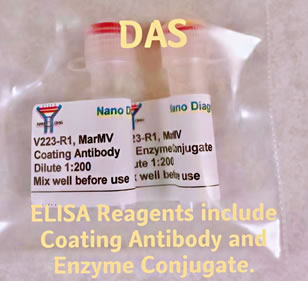 ELISA Reagents include Coating Antibody and Enzyme Conjugate.
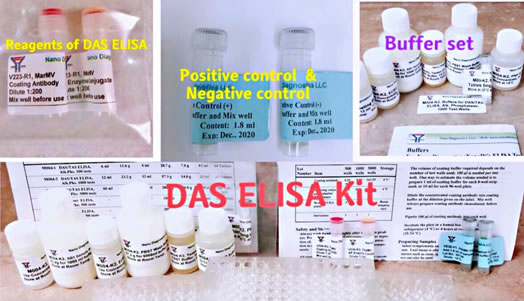
ELISA Kits include Coating Antibody and Enzyme Conjugate, all Buffer sets, Positive/Negative controls and all plates.
It is easy and convenient To Place
An Order
To know more about the products: Product
Items
To learn how to perform the test: Instructions
for DAS ELISA
To be familiar with other components: Buffer
Sets; Controls
Information About the Virus
Name: Sugarcane Mosaic Virus
Acronym: SCMV
Synonyms: Maize dwarf mosaic virus-B, abaca mosaic virus.
Group/Genus: Potyviruses
Vector: aphids
Transmission: Mechanical transmission. Seed transmission
in maize.
Main host plants: Maize, sugarcane, sorghum, abaca and grasses.
Viral Particle: Sugarcane mosaic virus (SCMV), formerly called Maize dwarf mosaic virus-B (MDMV-B), is a potyvirus. The virus has a flexible filamentary particle about 750 nm long and contains a single strand of RNA.
Virus Infection: SCMV is transmitted by several aphid species in a non-persistent manner and by mechanical inoculation. Seed transmission is found in maize, but not in sugarcane or sorghum. Based on host pants, there are many strains identified for SCMV, such as USA A, B, D, E, F in sugarcane and rarely in Johnsongrass, Australian SCMV strains BC, Sabi in grasses and strain SC in sugarcane. Maize dwarf mosaic strain B infects maize but does not infect Johnsongrass or sugarcane. Abaca mosaic strain is found in abaca and maize. Typical symptom of SCMV infection is mosaic. SCMV occurs worldwide, but does not infect wheat, barley, rye or rice naturally.
Reference: 1. Ford, Tosic and Shukla, 1989, CMI/AAB Descr. Pl.
Viruses, No. 342.
2. Shukla et al, 1989, Phytopathology 79: 223.
3. Shukla, Gough and Ward, 1987, Arch Virol. 96: 59.