Sowbane Mosaic Virus (SoMV) - DAS ELISA Home Products Testing Services Supplies Contact Us
Catalog #: V157
Source Antibody: Rabbit polyclonal antibody for both capture and
detection.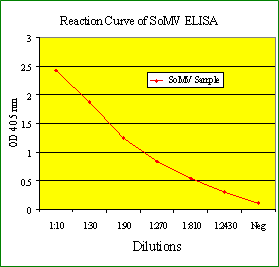
Test Format: DAS ELISA
Reactivity: The test reacted with all SoMV isolates tested. Reaction of the ELISA is moderate strong. Optical Density at 405nm is in arrange of 0.850 - >2.900 depending on the virus titer in the samples tested.
Sensitivity: Sensitivity of the ELISA is moderate high. The virus can be consistently detected in infected plant tissues diluted at 1:810 - 1:2430.
Specificity: There is no cross reaction with healthy plant tissues such as sowbane or other host plants. Background is low on all of the negative control wells.
Application: The test can be used to detect SoMV in infected host plants.
Products:
|
Catalog Number |
Description |
Test Wells | Price $USD |
Ship
Weight (Estimated) |
|
V157-R1 |
ELISA Reagents, Alkaline Phosphatase |
500 |
275 |
2 lb (1 kg) |
|
V157-R2 |
ELISA Reagents, Alkaline Phosphatase |
1000 |
470 |
3 lb (1.5 kg) |
|
V157-R3 |
ELISA Reagents, Alkaline Phosphatase |
5000 |
1860 |
12 lb (6 kg) |
| V157-R4 | ELISA Reagents, Alkaline Phosphatase |
100 |
105 |
1 lb (0.5 kg) |
| V157-K1 | ELISA Kit, Alkaline Phosphatase |
500 |
435 |
2 lb (1 kg) |
| V157-K2 | ELISA Kit, Alkaline Phosphatase |
1000 |
690 |
3 lb (1.5 kg) |
|
V157-C1 |
Coating Antibody |
500 |
140 |
2 lb (1 kg) |
|
V157-C2 |
Coating Antibody |
1000 |
260 |
2 lb (1 kg) |
|
V157-C3 |
Coating Antibody |
5000 |
885 |
2 lb (1 kg) |
|
V157-D1 |
Detecting conjugate, Alkaline Phosphatase |
500 |
190 |
2 lb (1 kg) |
|
V157-D2 |
Detecting conjugate, Alkaline Phosphatase |
1000 |
315 |
2 lb (1 kg) |
|
V157-D3 |
Detecting conjugate, Alkaline Phosphatase |
5000 |
1080 |
2 lb (1 kg) |
|
V157-P2 |
ELISA control, positive |
18 |
20 |
1 lb (0.5 kg) |
|
V157-N1 |
Negative control |
18 |
20 |
1 lb (0.5 kg) |
| M004-1 | Buffers for DAS/TAS, alkaline phosphatase | 500 | 130 |
2 lb (1.0 kg) |
| M004-2 | Buffers for DAS/TAS, alkaline phosphatase | 1000 | 220 |
3 lb (1.5 kg) |
| M004-3 | Buffers for DAS/TAS, alkaline phosphatase | 5000 | 900 |
6 lb (3.0 kg) |
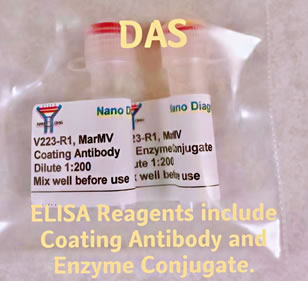 ELISA Reagents include Coating Antibody and Enzyme Conjugate.
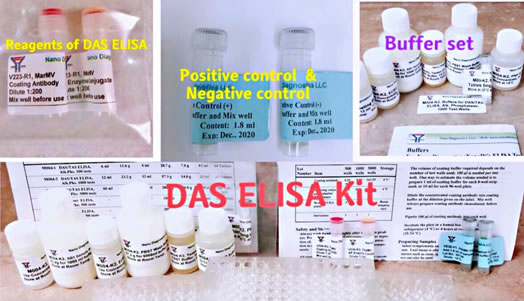
ELISA Kits include Coating Antibody and Enzyme Conjugate, all Buffer sets, Positive/Negative controls and all plates.
It is easy and convenient To Place
An Order
To know more about the products: Product
Items
To learn how to perform the test: Instructions
for DAS ELISA
To be familiar with other components: Buffer
Sets; Controls
Information About the Virus
Name: Sowbane Mosaic Virus
Acronym: SoMV
Synonyms: apple latent virus 2 (Bancroft and Tolin, 1967; Kirkpatrick et
al., 1965), chenopodium mosaic virus (Bennett and Costa, 1961; Dias and
Waterworth, 1967; Silva et al., 1958; Vuittenez, 1962), chenopodium
seed-borne mosaic virus (Dias and Waterworth, 1967), chenopodium star mottle
virus (Bancroft and Tolin, 1967)
Group/Genus: Sobemovirus
Vector: Transmitted by probably a vector; an insect; Myzus persicae,
Circulifer tenellus, Liriomyza langei, Halticus citri
(Bennett and Costa, 1961). Probably none of these transmit frequently or
specifically; Aphididae, or Cicadellidae, or Coleoptera (and Diptera). Not
transmitted by Myzus persicae; Dias and Waterworth (1967). Transmitted in
a non-persistent manner (Bennett and Costa, 1961). .
Transmission: Virus transmitted by mechanical inoculation; transmitted by
grafting; transmitted by seed (up to 60% in Chenopodium quinoa; Dias and
Waterworth, 1967, and 20-70% in Chenopodium murale; Bennett and Costa,
1961); transmitted by pollen to the seed and transmitted by pollen to the
pollinated plant (pollen contains much virus, Francki and Miles, 1985).
Main natural host plants: Chenopodium spp.; Vitis sp.,
Prunus domestica; Atriplex suberecta.
Virus Infection: causes fsystemic chlorotic mottling (Chenopodium
spp.). latent infection, but rarely infected (Vitis sp., Prunus
domestica). stunting and leaf deformation (Atriplex suberecta).
Symptoms persist.
Diagnostically susceptible host species and symptoms: Chenopodium
amaranticolor, C. quinoa, C. murale - chlorotic local lesions, systemic
yellow flecking, star shaped patterns, leaf deformation. Beta vulgaris -
mild systemic mosaic.
Geographical distribution: Spreads in the South and Central American region; Australia, Bulgaria, Canada, the former Czechoslovakia, Italy, Japan, the USA, and the former Yugoslavia.
References:
1. Kado, C.I. (1971). CMI/AAB Descr. Pl. Viruses No. 64, 4 pp.
2. Tremaine, J.H. and Ronald, W.P. (1977). Can. J. Bot.
55: 2274.