Clover Yellow Vein Virus - Strain C81 (ClYVV-C81) - DAS ELISA Home Products Testing Services Supplies
Catalog #: V120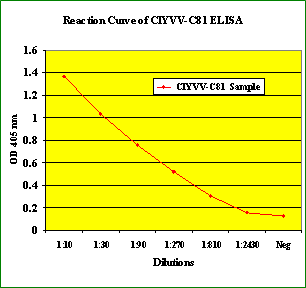
Source Antibody: Use a rabbit polyclonal antibodies made against
ClYVV-strain C81 for both capture and detection.
Test Format: DAS ELISA
Reactivity: This test system detects all known isolates of ClYVV - strain C81 and other serological related isolates. This test does not react with ClYVV - strain Pratt and some other serological distant isolates. Reaction of the ELISA is moderate. Optical Density at 405nm is in a range of 0.700 - 1.600 depending on the virus titer in the samples tested.
Sensitivity: Sensitivity of the ELISA is relatively high. The virus can be consistently detected in infected plant tissues diluted at 1:810.
Specificity: There is no cross reaction with healthy plant tissues. Background is relatively low on the negative control wells.
Application: The test can be used to detect ClYVV-strain C81 and other serological related isolates in infected host plants.
Products:
|
Catalog Number |
Description |
Test Wells | Price $USD |
Ship
Weight (Estimated) |
|
V120-R1 |
ELISA Reagents, Alkaline Phosphatase |
500 |
275 |
2 lb (1 kg) |
|
V120-R2 |
ELISA Reagents, Alkaline Phosphatase |
1000 |
470 |
3 lb (1.5 kg) |
|
V120-R3 |
ELISA Reagents, Alkaline Phosphatase |
5000 |
1860 |
12 lb (6 kg) |
| V120-R4 | ELISA Reagents, Alkaline Phosphatase |
100 |
105 |
1 lb (0.5 kg) |
| V120-K1 | ELISA Kit, Alkaline Phosphatase |
500 |
435 |
2 lb (1 kg) |
| V120-K2 | ELISA Kit, Alkaline Phosphatase |
1000 |
690 |
3 lb (1.5 kg) |
|
V120-C1 |
Coating Antibody |
500 |
140 |
2 lb (1 kg) |
|
V120-C2 |
Coating Antibody |
1000 |
260 |
2 lb (1 kg) |
|
V120-C3 |
Coating Antibody |
5000 |
885 |
2 lb (1 kg) |
|
V120-D1 |
Detecting conjugate, Alkaline Phosphatase |
500 |
190 |
2 lb (1 kg) |
|
V120-D2 |
Detecting conjugate, Alkaline Phosphatase |
1000 |
315 |
2 lb (1 kg) |
|
V120-D3 |
Detecting conjugate, Alkaline Phosphatase |
5000 |
1080 |
2 lb (1 kg) |
| V120-P2 | ELISA control, Positive |
18 |
20 |
1 lb (0.5 kg) |
|
V120-N1 |
Negative control |
18 |
20 |
1 lb (0.5 kg) |
| M004-1 | Buffers for DAS/TAS, alkaline phosphatase | 500 | 130 |
2 lb (1.0 kg) |
| M004-2 | Buffers for DAS/TAS, alkaline phosphatase | 1000 | 220 |
3 lb (1.5 kg) |
| M004-3 | Buffers for DAS/TAS, alkaline phosphatase | 5000 | 900 |
6 lb (3.0 kg) |
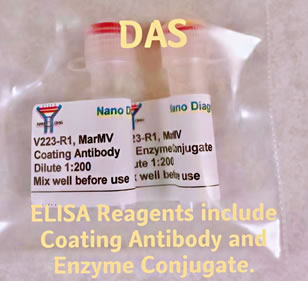 ELISA Reagents include Coating Antibody and Enzyme Conjugate.
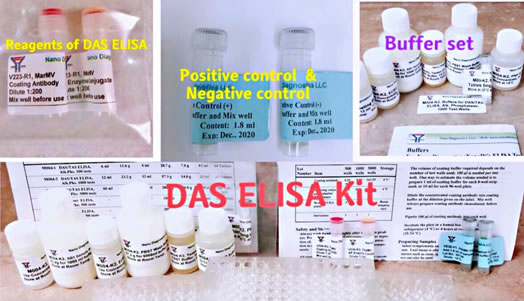
ELISA Kits include Coating Antibody and Enzyme Conjugate, all Buffer sets, Positive/Negative controls and all plates.
It is easy and convenient To Place
An Order
To know more about the products: Product
Items
To learn how to perform the test: Instructions
for DAS ELISA
To be familiar with other components: Buffer
Sets; Controls
Information About the Virus
Name: Clover Yellow Vein Virus -Strain C81
Acronym: ClYVV-C81
Synonyms: dendrobium mosaic virus, pea mottle virus (Pratt, 1961; Johnson,
1942), pea necrosis virus (Bos et al., 1977), probably alsike clover
mosaic virus, pea western ringspot virus.
Stains: There are many viral strains. CYVV-Pratt is typical isolate.
Others are distantly related to the type isolates.
Group/Genus: Potyvirus
Vector: Transmitted by a vector; an insect; Acyrthosiphon (Aulacorthum)
solani, Macrosiphum euphorbiae, Myzus persicae (Singh et al., 1971);
Aphididae. Transmitted in a non-persistent manner.
Transmission: Virus transmitted by mechanical inoculation.
Main natural host plants: Coriandrum sativum, Daucus carota (wild
and domestic), Pisum sativum, Trifolium hybridum, T. incarnatum, T. pratense,
T. repens, T. subterraneum, T. vesiculosum, Limonium sinuatum,
Lupinus luteus, Lupinus sp., Glycine max - (Jones et al.,
1977).
Virus Infection: Symptoms include mosaics, mottles or
streaks, vein yellowing or netting. Symptoms vary seasonally.
Diagnostically susceptible host species and symptoms: Chenopodium
quinoa - chlorotic or necrotic local lesions; systemic mosaic and necrosis;
Phaseolus vulgaris - chlorotic local lesions; systemic mosaic;
Nicotiana clevelandii - chlorotic or necrotic local lesions; systemic mosaic
and necrosis; N. tabacum - necrotic ringspots; not systemic; Trifolium
repens - mosaic and chlorotic banding or symptomless
Geographical distribution: Probably distributed worldwide (wherever white clover occurs).
References:
1. Barnett, O.W., Randles, J.W. and Burrows, P.M. (1987).
Phytopathology 77: 791.
2. Hollings, M. and Stone, O.M. (1974). CMI/AAB Descr. Pl.
Viruses No. 131, 4 pp.
3. Lawson, R.H., Brannigan, M.D. and Foster, J. (1985).
Phytopathology 75: 899.