Phytophthora (Phyt) - TAS ELISA Home Products Testing Services Supplies
Catalog #: F111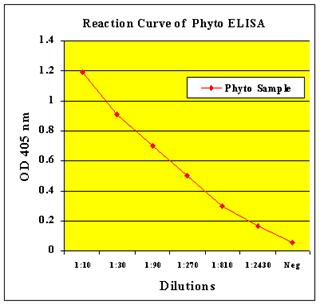
Source Antibody: A rabbit polyclonal antibody for capture and a
monoclonal antibody for detection.
Test Format: TAS ELISA
Reactivity: This ELISA detects at least the following 16 Phytophthora species: P. cactorum, P. cambivora, P. capsici, P. cinnamomi, P. citricola, P. citrophthora, P. cryptogea, P. drechsleri, P. erythroseptica, P. fragariae, P. infestans, P. megasperma, P. palmivora, P. parasitica, and P. sojae. It reacted with all 39 isolates of Phytophthora infestans tested.
Reaction of this test is moderately strong. Optical Density at 405nm is in a range of 0.480 - 1.800 depending on the fungal titers in the samples tested.
Sensitivity: Sensitivity of the ELISA is moderately high. The fungus can be consistently detected in infected plant tissues diluted at 1:270 - 1:810.
Specificity: This test system reacts negatively with the following species of fungi: Pythium aphanidermatum, P. catenulatum, P. heterothalicum, P. irregulare, P. oligandrum, P. spinosum, P. splendens, P. torulosum, P. ultimum, P. ultimum var. ultimum. The test did not react with isolates of Aspergillussp., Fusarium sp., Monilinia sp., Penicilliumsp., Rhizoctonia sp., and Sclerotiniasp. There are moderate cross-reaction occurring with pure culture extracts of Pythium aristosporum, P. arrhenomanes, P. graminicola, P. paroecandrum, and P. violae, and weak cross-reaction occurring with pure culture extracts of Pythium multisporum, P. myriotylum, P. sylvaticum, P. tardicrescens, P. vanterpoolii.
There is no cross reaction with healthy plant tissues. Background is low on all of the negative control wells.
Application: The test can be used to detect the fungi in many host plant tissues infected with Phytophthora spp., such as leaves, stems, roots, seeds, and potato tubers, as well as in pure fungal cultures.
Products:
|
Catalog Number |
Description |
Test Wells | Price $USD |
Ship
Weight (Estimated) |
|
F111-R1 |
ELISA Reagents, Alkaline Phosphatase |
500 |
275 |
2 lb (1 kg) |
|
F111-R2 |
ELISA Reagents, Alkaline Phosphatase |
1000 |
470 |
3 lb (1.5 kg) |
|
F111-R3 |
ELISA Reagents, Alkaline Phosphatase |
5000 |
1860 |
12 lb (6 kg) |
| F111-R4 | ELISA Reagents, Alkaline Phosphatase |
100 |
105 |
1 lb (0.5 kg) |
| F111-K1 | ELISA Kit, Alkaline Phosphatase |
500 |
435 |
2 lb (1 kg) |
| F111-K2 | ELISA Kit, Alkaline Phosphatase |
1000 |
690 |
3 lb (1.5 kg) |
|
F111-C1 |
Coating Antibody |
500 |
140 |
2 lb (1 kg) |
|
F111-C2 |
Coating Antibody |
1000 |
260 |
2 lb (1 kg) |
|
F111-C3 |
Coating Antibody |
5000 |
885 |
2 lb (1 kg) |
|
F111-D1 |
Detecting conjugate, Alkaline Phosphatase |
500 |
190 |
2 lb (1 kg) |
|
F111-D2 |
Detecting conjugate, Alkaline Phosphatase |
1000 |
315 |
2 lb (1 kg) |
|
F111-D3 |
Detecting conjugate, Alkaline Phosphatase |
5000 |
1080 |
2 lb (1 kg) |
|
F111-P1 |
Positive control |
18 |
20 |
1 lb (0.5 kg) |
|
F111-N1 |
Negative control |
18 |
20 |
1 lb (0.5 kg) |
| M004-1 | Buffers for DAS/TAS, alkaline phosphatase | 500 | 130 | 2
lb (1.0 kg) |
| M004-2 | Buffers for DAS/TAS, alkaline phosphatase | 1000 | 220 | 3
lb (1.5 kg) |
| M004-3 | Buffers for DAS/TAS, alkaline phosphatase | 5000 | 900 | 6
lb (3.0 kg) |
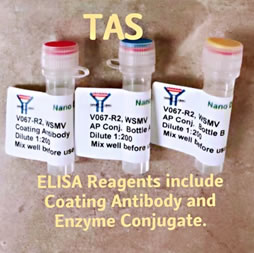 ELISA Reagents include Coating Antibody and Enzyme Conjugate.
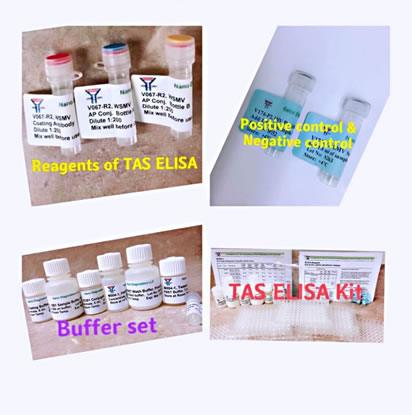 ELISA Kits include Coating Antibody and Enzyme Conjugate, all Buffer sets, Positive/Negative controls and all plates
It is easy and convenient To Place
An Order
To know more about the products: Product
Items
To learn how to perform the test: Instructions
for DAS ELISA
To be familiar with other components: Buffer
Sets; Controls
Information About the Fungus
Name: Phytophthora
Acronym: Phyt
Synonyms:
Group/Genus: Phytophthora
Transmission: Air-born sporangia, infected plant tissues,
seed, tuber, soil and agricultural activities.
Main host plants: Wide range of host plants including many
important crops.
Fungal Structures: Sporangia, Sporangial spores, Mycelia.
Fungal Infection: The fungi infect leaves, stems, roots,
tubers and other organs of host plants. The infected plant shows various
symptoms including leaf lesions, stem cankers, root and tuber rotting, or the
death of whole plant.
Reference: